AI Code Review: 7 Best Practices for 2026
AI code review earns trust through a clear role, maintained context, bounded permissions, evidence, and accountable approval.
AI code review now ranges from single-pass diff readers to agentic reviewers that explore a repository, load team instructions, use approved tools, and investigate possible issues before reporting them.
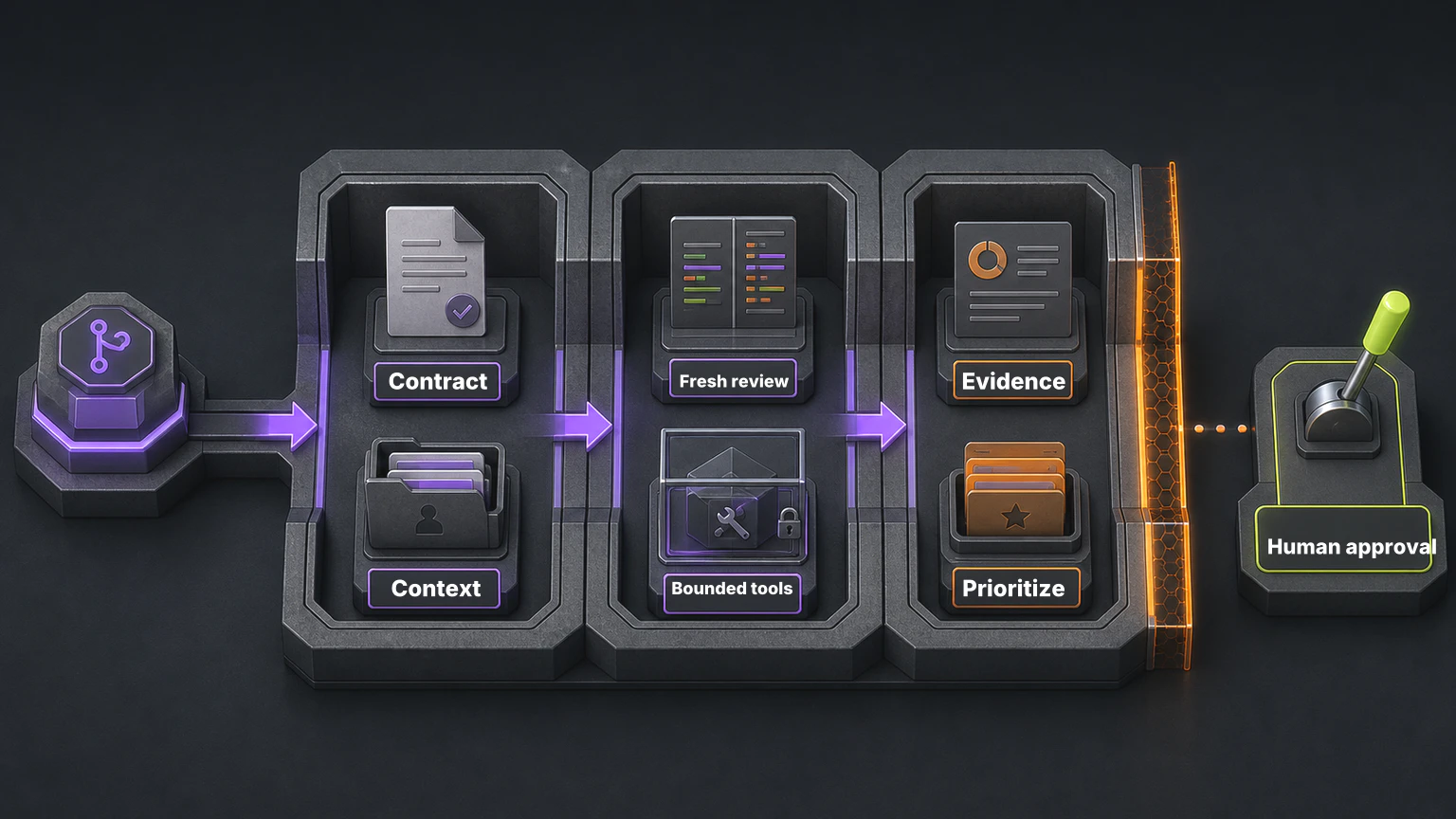
To make AI code review work, define its review contract, give it maintained context, separate authoring from a fresh-context review pass, restrict its tools, require evidence, and leave approval with an accountable person. Workflow determines whether output earns trust.
That range changes adoption. A diff reader and a tool-using agent need different context, permissions, and evidence. GitLab’s June 2026 research reports that review and validation are becoming bottlenecks. Trustworthy review matters more.
What AI Code Review Means in 2026
AI code review uses language models to inspect a proposed change for defects, security issues, maintainability problems, and violations of team rules.
Two review patterns now coexist:
| Review pattern | What it does | Main limitation |
|---|---|---|
| Diff-focused AI review | Reads the change and nearby context, then returns comments or suggested edits | Can miss relevant behavior outside the retrieved context |
| Agentic code review | Explores the repository in multiple steps, retrieves connected context, and can use tools to investigate a finding | Adds tool, permission, cost, and prompt-injection risk |
GitLab’s documentation separates multi-step agentic review from single-pass review. GitHub also uses agentic code review for review from its CLI.
The term is not standardized. Compare context access, tools, permissions, and verification behavior instead of relying on the agentic label.
AI review can reason about intent and surrounding code, but it remains probabilistic. GitHub’s Copilot documentation states that its comments do not count as required approval and its review does not block a merge.
Why AI Review Fails
Common workflow failures include an undefined contract, stale context, self-review treated as separate evidence, and a clean result treated as proof. “Review this code” produces broad commentary instead of prioritized findings. A clean review means only that the model reported no issue in what it inspected. It does not prove that the feature works or existing behavior remains intact.
Seven AI Code Review Best Practices
1. Define the review contract
State what the reviewer owns, ignores, and must show. Focus it on correctness, authorization, error paths, and API contracts. Leave deterministic rules to specialized tools. Require each finding to identify the code, failure mode, and evidence.
A compact review contract can be this explicit:
Review the change for correctness, authorization, error handling, and the stated acceptance criteria. Ignore formatting and issues unrelated to changed behavior. Report only findings with a concrete failure scenario and supporting code evidence. Use read-only tools. Do not modify code. State which checks you ran and which relevant checks you could not run.
2. Separate authoring from review
Self-review is useful, but a fresh session is only a separate review pass. Give it the original issue, acceptance criteria, final diff, and validation results. Preserve the authoring session, commands, and tests as provenance. For stronger independence, add a qualified human, specialist control, different model, or materially different toolchain.
3. Build a context stack
Give the reviewer maintained context, not an unfiltered data dump:
- Repository-wide rules for architecture, security, and testing.
- Path-specific instructions for components with different standards.
- The issue, acceptance criteria, and pull request description.
- Task-specific review skills or checklists.
- Approved issue, documentation, or test tools when needed.
On GitHub.com, Copilot code review supports repository and path-specific instructions and AGENTS.md. Review skills and Model Context Protocol (MCP) tools remain in public preview on supported surfaces. GitHub’s support reference shows that review surfaces do not all load the same files. Keep instructions scoped, owned, and current.
4. Keep changes reviewable
AI does not make an oversized pull request easy to reason about. Keep changes small and self-contained. Google’s small-change guidance applies to people and models. State the goal, affected systems, tradeoffs, and validation rather than making the reviewer infer intent.
5. Bound tools and untrusted input
Code, issues, comments, logs, and instruction files are untrusted input. Use read-only access by default, allow only required tools, keep secrets unavailable, and require approval before consequential commands. GitLab’s code-review guardrails isolate code content to reduce prompt-injection risk. GitHub’s broader cloud-agent security guidance treats issues and comments as prompt-injection sources. GitHub Copilot code review reads head-branch instructions and skills, so a pull request can influence its own review context.
6. Require evidence, not comments
An AI comment is a hypothesis until it is supported. Confirm a possible defect with code, a focused test, or a reproducible path. Route security findings through the appropriate control or specialist. Keep each layer responsible for its own question:
| Layer | Primary question | Typical evidence |
|---|---|---|
| Static analysis | Does the code violate a deterministic rule? | Reproducible rule result |
| AI code review | Does this change contain a plausible defect or poor decision? | Finding tied to code and supporting context |
| Tests | Does the implementation satisfy specified examples? | Passing and failing execution |
| Human review | Is this the right change and tradeoff? | Accountable engineering judgment |
| Regression review | What established behavior might this change put at risk? | Change impact across product behavior |
Record which commands ran and which checks were skipped or failed. Evidence remains distinct from the model’s explanation, even when the reviewer runs the tool.
7. Pilot with human accountability
The human reviewer still owns product intent, architecture, privacy, security tradeoffs, operability, and final approval. Retain specialist controls for high-risk changes. Before broad rollout, evaluate AI review on representative pull requests or a seeded defect set:
| Metric | What it reveals |
|---|---|
| Actionable-finding precision | How many reported findings deserve action |
| Seeded-defect recall | How many known defects the workflow finds |
| Severity calibration | Whether priority matches actual risk |
| Time to useful feedback | Whether review improves delivery latency |
Track escaped defects separately. Comment volume and acceptance rate are weak quality measures because developers may accept noise or fix valid issues differently. Use results to improve context and remove low-value rules.
What AI Review Should Catch
| Strong use | Use with caution | Use another control |
|---|---|---|
| Missing edge cases in changed logic | Broad architectural conclusions | Formatting and deterministic style |
| Inconsistent error handling | Performance or concurrency claims without measurement | Dependency vulnerability databases |
| Unsafe input or authorization handling | Product intent inferred from code alone | Required human approvals |
| Violations of written team rules | Cross-system impact outside available context | Runtime monitoring |
| Cross-file inconsistencies when relevant files are available | Claims that existing behavior is unchanged | Regression analysis and execution evidence |
Use these boundaries when comparing the best AI code review tools in 2026.
Treat CI workflows, infrastructure as code, deployment manifests, migrations, permissions, and feature flags as high risk. AI may find local defects, but these changes still need policy checks, plans, rollback review, and specialist approval.
Code Review vs Regression Review
Regression Intelligence is not code review with a larger context window. It asks a different question.
| Review | Primary question | Working context |
|---|---|---|
| Code review | Is the proposed change correct? | The pull request, acceptance criteria, changed feature, and relevant repository context |
| Regression review | What established behavior could this change affect? | The release candidate, behavior baseline, and product, project, and system relationships |
Anthropic’s April 2026 Claude Code postmortem shows why the distinction matters. A context-management bug passed human and automated review, tests, verification, and dogfooding. A later back-test found it with a newer model and additional repositories. Review quality depended on model and context, while several controls shared the same miss.
Code review can pass while behavior outside its scope changes. That is why verifying AI-generated code is a different job from reviewing it. Regression review examines that wider behavior risk.
AI Code Review Checklist
Before rolling AI review across a team, confirm that:
- The review contract and severity policy are explicit.
- Authoring and the fresh-context review pass use separate sessions.
- Instructions, skills, and connected context are current.
- Permissions and tools match the review task.
- Findings point to code and supporting evidence.
- High-risk changes retain specialist controls.
- A qualified human owns the merge decision.
- The team measures useful findings, noise, and escaped defects.
Frequently Asked Questions
Should the same AI write and review code?
A fresh session provides a separate review pass, not independent evidence. Retain human or specialist approval for meaningful changes.
How do you reduce false positives?
Define the contract, scope instructions by path, remove deterministic checks, require evidence, and track accepted and dismissed findings.
How is regression review different?
Code review asks whether the proposed change is correct. Regression review asks what established behavior it could affect across the product, projects, and known system relationships. The jobs are different. The five-layer vibe coding guardrail stack shows how production teams combine them around agent-generated changes.
Make Review Earn Trust
The best AI code review workflow does not ask developers to trust a model more. It makes the review process inspectable.
Define the contract. Supply maintained context. Separate authoring from review. Restrict tools. Demand evidence. Keep a person accountable for the decision.
AI review earns a place in the workflow when it helps people understand a change without pretending to answer questions outside its scope.