How to Evaluate AI Bug-Fixing Tools
Evaluate the fix, inspect the evidence, and measure the work left before acceptance.
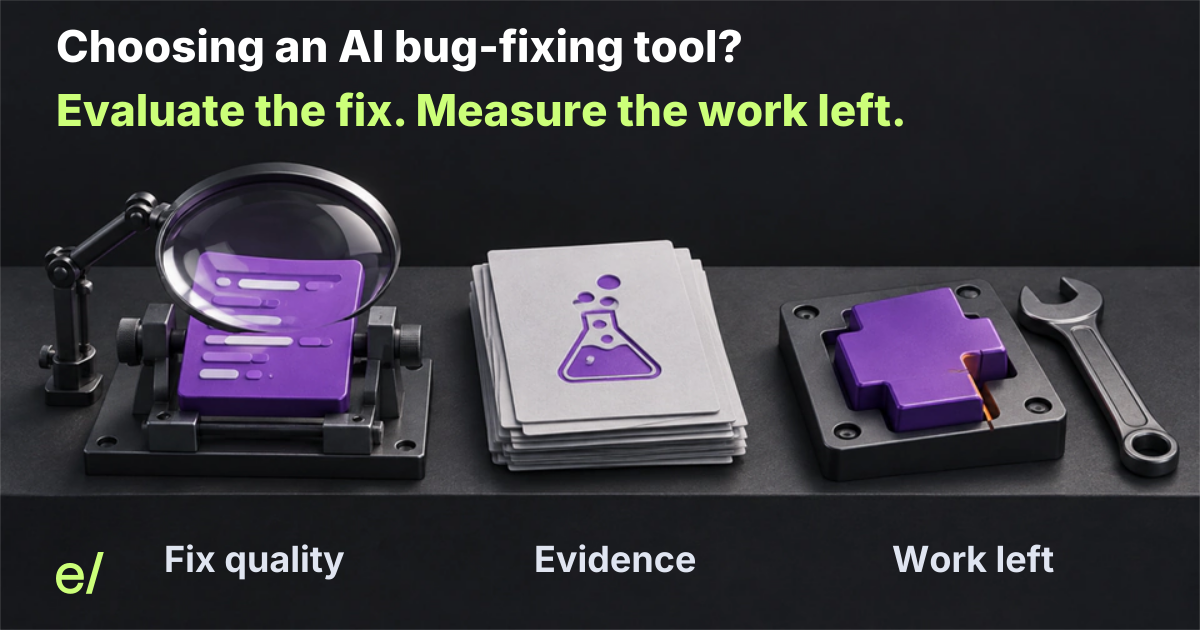
An AI tool opens a pull request with a code change, tests, and a convincing explanation. That is useful work. It is also the point where the evaluation becomes more important: does the change fix the actual problem, what supports that conclusion, and how much work remains before the team can accept it?
Evaluate AI bug-fixing tools on six criteria: finding quality, repair scope, verification evidence, human control, workflow fit, and pilot outcomes. Use representative defects from your own environment, define acceptance criteria beforehand, and count unsuccessful attempts as well as successful fixes.
The goal is not to choose the tool that produces the most patches. It is to identify which tool produces correct, reviewable fixes with evidence your team can inspect, while reducing the effort required to reach a justified decision. An accepted or merged pull request does not, by itself, establish that the bug was resolved.
Separate Discovery From Repair
Before comparing tools, decide which job you are evaluating. Bug discovery asks whether a tool can identify a real defect and explain its consequences. Bug repair asks whether it can implement an appropriate correction for a known defect. A product may support both, but success at one does not establish success at the other.
For a discovery evaluation, provide the agreed code scope and assess the findings against independently reviewed evidence. Record valid findings, incorrect findings, and missed known defects within that scope. Do not call every unmatched finding a false positive simply because nobody has investigated it yet.
For a repair evaluation, give each tool the same defect description, expected behavior, starting revision, and permitted context. Record any additional hints or operator intervention. A repair produced after several rounds of expert guidance is different from one produced from the original finding, even when both patches are useful.
Evaluate the combined workflow separately: what happens when the tool must discover the issue and carry it into a fix? This avoids crediting repair capability with a diagnosis that an engineer supplied.
Six Criteria for AI Bug-Fixing Tools
Use these questions to structure a demonstration or pilot. Ask to inspect the artifacts behind the answer, not only a summary screen.
| Criterion | Question to ask | Evidence to request | Warning sign |
|---|---|---|---|
| Finding quality | What demonstrates the defect and expected behavior? | Failure scenario, relevant code, requirements, and reproduction where feasible | A suspicious pattern presented as a confirmed bug |
| Repair scope | Why does this change address the cause? | Focused diff, rationale, affected behavior, and necessary supporting changes | Unexplained refactoring or a patch that merely hides the symptom |
| Verification | What actually ran against the repaired revision? | Test assertions, commands, revision, environment, results, and skipped checks | Generated tests or compilation described as behavioral proof |
| Human control | Who authorizes repair and accepts the change? | Permissions, initiation steps, review requirements, and recovery procedure | Branch writes or merge authority broader than the team intended |
| Workflow fit | What arrives for review, and what happens on failure? | Finding-to-patch links, execution record, failure handling, and handoff | Failures disappear or require undocumented operator work |
| Pilot outcomes | Are repairs useful, correct, and economical to review? | Outcome records, rework, review effort, unresolved cases, and follow-up checks | Pull request volume used as the main success measure |
Finding Quality and Repair Scope
A useful finding explains a failure under stated conditions. It should give the reviewer enough context to distinguish a defect from an intentional policy or an unsupported assumption.
For example, continuing after a failed read may be intentional. Overwriting previously valid data afterward is a different behavior that needs its own justification. The repair should address the agreed failure without silently changing unrelated behavior.
Ask reviewers to explain why the patch works in their own words. Include necessary tests and documentation in the scope assessment. A small diff is not automatically correct, and a multi-file change is not automatically excessive. The question is whether each change is necessary and understandable.
Tests and Verification Evidence
For AI-generated fixes, inspect the tests as carefully as the implementation. A test can repeat the same mistaken assumption as the patch. Establish expected behavior from requirements, contracts, or a reviewed reproduction rather than treating agreement between generated artifacts as independent confirmation.
Where feasible, run the relevant behavioral test against the original and repaired revisions. Confirm that the original fails for the intended reason, the repaired version passes, and important surrounding behavior still works. Record limitations when an environment, dependency, or nondeterministic failure prevents that comparison.
Keep compilation, static analysis, unit tests, integration tests, and operational observations separate. Each answers different questions. For deeper guidance, see Verifying AI-Generated Code. GitHub likewise advises users to review and test agent-generated code rather than treating valid-looking output as evidence of correctness.
Human Control and Workflow Fit
Ask what authorizes repair initiation, which repositories and branches the tool can modify, what credentials it receives, and who can merge. Confirm that the team can inspect, amend, reject, and stop the work through its normal process.
Then test the inconvenient cases. What happens when the environment does not start, the patch cannot be applied, the tool cannot produce a suitable repair, or the tests fail? A visible failure with a usable handoff can be more valuable than an apparently completed task that conceals unfinished work.
Also inspect the path after acceptance. A repository revert may not reverse a data migration or an external side effect. Recovery requirements should follow the change, not a generic promise that every fix can simply be rolled back.
Design a Bounded Pilot
Choose a manageable sample that reflects the work your team actually faces. Include straightforward defects, cases requiring broader context, and relevant failure paths. Record severity and complexity so that easy fixes do not hide weak performance on the cases that matter most.
Use known defects for controlled repair comparisons and a separate sample for discovery. Do not supply the known solution to one tool while expecting another to infer it. Keep starting revisions, environments, available context, and intervention rules consistent enough to make the comparison meaningful.
Before the first run, agree on required evidence, unacceptable behavior, review ownership, and the conditions for continuing or stopping. Set criteria appropriate to the risk. A small internal formatting utility and a persistence path that can lose data should not have identical acceptance requirements.
Public benchmarks can inform a shortlist, but they do not replace this exercise. For example, SWE-bench reports distinguish patches that satisfy required tests from unresolved attempts, empty patches, and evaluation errors. Preserve those distinctions when interpreting results rather than treating an ungraded attempt as a success.
Measure Correctness and Remaining Work
Maintain one record for every selected case, including unsupported cases and attempts that produce no patch. Track the repair disposition separately from the evidence: accepted, reworked, rejected, or unresolved describes a review outcome, not proof of resolution.
Record which behavior was checked, against which revision, and what remains uncertain. After merge or deployment, follow up where appropriate to confirm the original failure no longer occurs and to investigate regressions. Do not silently convert “merged” into “fixed.”
Measure human effort across setup, diagnosis, prompting, review, rework, and verification. Separate active engineering time from elapsed waiting time, and include vendor or operator assistance. A tool that generates a patch quickly may still require substantial work before acceptance.
Compare that effort with your existing repair process on reasonably comparable cases. Record differences in complexity and avoid claiming precise savings from a small or uneven sample. The useful outcome is evidence for a decision, not a flattering percentage.
Inspect a Real Evidence Package
The Pydantic AI saved-state Case File illustrates what a buyer can inspect. Early identified a failure involving saved state and, after authorized initiation, implemented a repair with a test in a draft pull request on Early’s fork.
In the documented record, the compilation check passed, but the added behavioral test had not been executed. That is an inspectable repair artifact, not a completed demonstration of behavioral correctness or upstream acceptance.
Use the example to ask what your team would require next: which assertions need review, which checks must run, and who accepts the remaining uncertainty. The AI bug-fixing workflow guide explains the case in detail.
Early Release Guard’s Find. Fix. Know. workflow connects bug findings, implemented fixes and tests, and available verification evidence. Authorized initiation and eligible findings define the repair scope. Engineers review, amend, and control the merge. Evaluate that workflow against the same criteria you apply to other tools.
Before You Expand the Pilot
- Define expected behavior and the evidence required for acceptance.
- Evaluate discovery and known-bug repair separately.
- Use representative cases with recorded starting revisions and context.
- Count failed, unsupported, rejected, and unresolved attempts.
- Inspect tests and execution results, including checks not run.
- Measure setup, review, rework, verification, and operator assistance.
- Keep merge status separate from verified resolution.
- Decide whether to expand, continue investigating, or stop against the criteria agreed beforehand.
The right tool should help the team reach correct, reviewable repairs with less avoidable work. Faster patch creation matters when it advances that outcome, not when it merely moves unfinished work into a pull request.